-
- KR Discusses Emissions and Digitalization During 2026 Southeast Asia Committee Meeting and Technical Seminar
- KR and HD Hyundai Advance Korea's Green Shipping Corridor Through Ammonia Vessel Trial
- KR Leads World-First Pilot Demonstration of MobED, Hyundai Motor and Kia's Autonomous Mobile Robot Platform, aboard HYUNDAI DUBAI
- KR Certifies 3D Printing Technology, Expanding Applications from New Part Production to Maintenance and Repair in Defense and Shipbuilding
-
- III12 - News Brief.
- (2026-IMO-05(E)) Approval of BWMP and issuance of IBWM Certificate for all Panamanian flagged ships(rev.1).
- (2025-IMO-17(Rev.1)) Amendments to Pilot Transfer Arrangement Requirements Entering into Force on 1 January 2028(Rev.1).
- (2025-IMO-16(Rev.2)) Implication Analysis on Draft Amendments to the IGC Code (Rev.2).
- (2026-IMO-06(E)) Guidance to Support the Early Implementation of Requirements for Pilot Transfer Arrangements.
- Guidance on Secondary Means of Support for Accommodation Ladders on Vessels Calling at the Port of Dampier
- List of National Operational Contact Points for SOPEP/SMPEP (Latest Update: 31 July 2026)
- Revision of " Guidelines for Ships carrying Liquefied Hydrogen in Bulk"
- KR Discusses Emissions and Digitalization During 2026 Southeast Asia Committee Meeting and Technical Seminar
- KR and HD Hyundai Advance Korea's Green Shipping Corridor Through Ammonia Vessel Trial
- KR Leads World-First Pilot Demonstration of MobED, Hyundai Motor and Kia's Autonomous Mobile Robot Platform, aboard HYUNDAI DUBAI
- KR Certifies 3D Printing Technology, Expanding Applications from New Part Production to Maintenance and Repair in Defense and Shipbuilding
- III12 - News Brief.
- (2026-IMO-05(E)) Approval of BWMP and issuance of IBWM Certificate for all Panamanian flagged ships(rev.1).
- (2025-IMO-17(Rev.1)) Amendments to Pilot Transfer Arrangement Requirements Entering into Force on 1 January 2028(Rev.1).
- (2025-IMO-16(Rev.2)) Implication Analysis on Draft Amendments to the IGC Code (Rev.2).
- (2026-IMO-06(E)) Guidance to Support the Early Implementation of Requirements for Pilot Transfer Arrangements.
- Guidance on Secondary Means of Support for Accommodation Ladders on Vessels Calling at the Port of Dampier
- List of National Operational Contact Points for SOPEP/SMPEP (Latest Update: 31 July 2026)
- Revision of " Guidelines for Ships carrying Liquefied Hydrogen in Bulk"
-
- KR Discusses Emissions and Digitalization During 2026 Southeast Asia Committee Meeting and Technical Seminar
- KR and HD Hyundai Advance Korea's Green Shipping Corridor Through Ammonia Vessel Trial
- KR Leads World-First Pilot Demonstration of MobED, Hyundai Motor and Kia's Autonomous Mobile Robot Platform, aboard HYUNDAI DUBAI
- KR Certifies 3D Printing Technology, Expanding Applications from New Part Production to Maintenance and Repair in Defense and Shipbuilding
-
- III12 - News Brief.
- (2026-IMO-05(E)) Approval of BWMP and issuance of IBWM Certificate for all Panamanian flagged ships(rev.1).
- (2025-IMO-17(Rev.1)) Amendments to Pilot Transfer Arrangement Requirements Entering into Force on 1 January 2028(Rev.1).
- (2025-IMO-16(Rev.2)) Implication Analysis on Draft Amendments to the IGC Code (Rev.2).
- (2026-IMO-06(E)) Guidance to Support the Early Implementation of Requirements for Pilot Transfer Arrangements.
- Guidance on Secondary Means of Support for Accommodation Ladders on Vessels Calling at the Port of Dampier
- List of National Operational Contact Points for SOPEP/SMPEP (Latest Update: 31 July 2026)
- Revision of " Guidelines for Ships carrying Liquefied Hydrogen in Bulk"
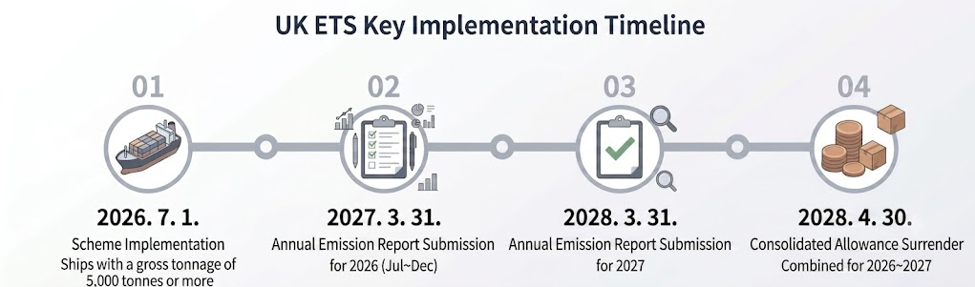
Green Technology Team Kangil Pyeon, Taegyeong Noh, Nohyun Ahn The Significance of UK ETS Expansion to the Shipping Sector The Emissions Trading System (ETS) is a leading market-based measure that attaches a price signal to greenhouse gas emissions in order to drive reductions. Whereas the existing MRV framework merely measured and reported emissions, ETS requires operators to actually surrender allowances corresponding to their emissions. In other words, because emissions translate directly into cost, the effectiveness of regulation is significantly strengthened. Operators that reduce emissions efficiently within their allocated allowance can sell their surplus allowances, while those that exceed their allowance must procure the shortfall from the market. The shipping sector, too, is rapidly moving beyond simply managing emissions volumes toward a system in which actual emissions carry real economic cost. Against this backdrop, the United Kingdom has completed preparations to fully apply its own independent ETS regime to shipping calling at UK ports. Since leaving the EU, the UK has operated a separate UK MRV framework; however, the absence of an integrated reporting and compliance system has left persistent regulatory gaps and practical uncertainty in the shipping sector. To address this, rather than leaving the existing UK MRV as a simple reporting framework, the UK government chose to incorporate shipping emissions into UK ETS, directly linking them to a reduction obligation. As a result, from 1 July 2026, shipping companies operating vessels of 5,000 GT and above will bear a series of obligations, including establishing an emissions monitoring plan, submitting an annual emissions report, and surrendering allowances (UKA). This is not merely a change in the name of the system — it signals a shift for shipping calling at UK ports from a ‘reporting-centred’ to an ‘allowance-surrender-centred’ regulatory regime. Accordingly, shipping companies calling at UK ports must also prepare for this new regulatory framework. Who and What Is Covered The greenhouse gases regulated under UK ETS are CO₂, CH₄, and N₂O. The vessels currently covered are cargo and passenger ships of 5,000 GT and above, with an expansion to the 400–5,000 GT segment under review (offshore vessels are scheduled to be included from 1 January 2027). Coverage is determined not by a vessel’s entire voyage, but by the maritime activity that takes place within UK jurisdiction. Specifically, allowance surrender applies to 100% of emissions from in-port activity within UK-regulated ports, 100% of emissions from UK domestic voyages, and 50% of emissions from voyages between Great Britain (GB) and Northern Ireland (NI). By contrast, emissions generated on international voyage legs between the UK and third countries, including the EU, are not currently covered under UK ETS. However, the UK government is considering incorporating a portion of international voyage emissions around 2028, so the scope of application may expand in the future. The Four-Step Compliance Process and Competent Regulatory Authorities Compliance under UK ETS proceeds in four steps. ① A shipping company must submit an Emissions Monitoring Plan (EMP) — covering all vessels under its management as a single plan — through the UK government’s online platform, METS, and have it approved (within 42 days of the first maritime activity); ② emissions are then monitored using the approved method; ③ an Annual Emissions Report (AER) is prepared by compiling data for the reporting period; and ④ after verification by an accredited verification body, the AER is submitted and allowances (UKA) are surrendered. The competent regulatory authority depends on where the shipping company is registered. Companies with a registered office or residence in the UK fall under the regulator for that region, while for domestic (Korean) companies without a UK registered office, the Environment Agency (EA) of England serves as the competent regulatory authority in principle. In addition, in 2026 — the first year of implementation — the first reporting period covers the six months from 1 July to 31 December, and the first AER for this period must be submitted by 31 March 2027. Allowance surrender is normally due by 30 April of the year following each reporting year; however, in consideration of the burden on companies during the initial rollout, allowances for the 2026 and 2027 reporting years may be surrendered together, with the deadline deferred to 30 April 2028.
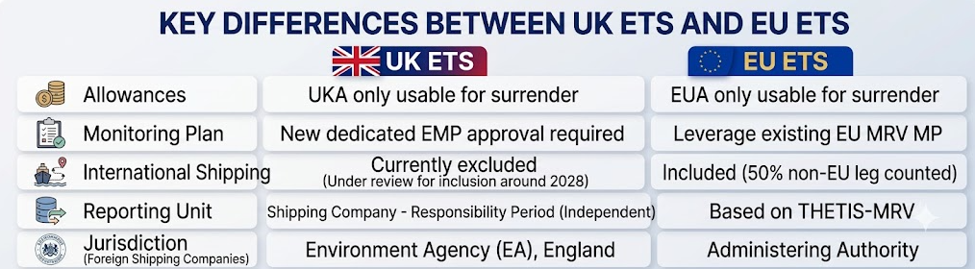
How UK ETS Differs from EU ETS — Key Points for Korean Shipowners At first glance, UK ETS may appear similar to EU ETS given the similarity in name, but there are considerable differences in the actual implementation structure and practical operation. Shipping companies calling at both UK and EU ports should therefore avoid treating the two systems as a single unified framework, and instead respond on the premise that allowance management, monitoring plans, reporting methods, the scope of covered voyages, and regulatory jurisdiction all differ between the two. The most important practical difference is that UKA and EUA must each be secured and managed separately, and the two types of allowances cannot be used interchangeably. Furthermore, because UK ETS and EU ETS differ in covered voyages, submission platforms, report formats, and regulatory jurisdiction, emissions from the same vessel should not be processed through a single unified reporting workflow. UK ETS operates an EMP/AER submission system through METS, while EU ETS operates an MP/ER-CER submission system through THETIS-MRV — it is important to manage the two as separate regulatory frameworks.
KR’s Role — Response as a UKAS-Accredited Verification Body KR, as a verification body accredited for shipping-sector verification by the UK’s national accreditation body, UKAS, comprehensively assesses the AERs submitted by shipping companies and issues Verification Reports (VR). Verification is carried out based on a risk-based approach, applying a materiality threshold of 2% for total emissions exceeding 500,000 tCO₂eq, and 5% for emissions at or below that level. Where necessary, on-site visits are conducted to a company’s shore-based offices and vessels; with the prior approval of the regulatory authority, these may be replaced by virtual site visits. Where a misstatement or non-conformity is identified during verification, corrections are requested, and recommendations for improving the monitoring system going forward are provided together with the findings. Ahead of the system’s implementation, KR published Technical Circular 2026-ETC-02, containing practical implementation guidance, to support the early response of domestic shipping companies, and plans to provide one-stop technical support throughout the entire process, from EMP preparation to AER verification. In addition, KR is preparing to introduce a UK ETS Voyage Statement service that compiles and provides voyage-level emissions data, which is expected to further ease the reporting burden on shipping companies. Conclusion The incorporation of the shipping sector into UK ETS represents both a new compliance burden for shipping companies and a signal of the shift toward a decarbonized era in which emissions carry real cost. In particular, subtle differences from EU ETS — including the non-interchangeability of UKA and EUA, the treatment of international voyages, and the company-level reporting structure — could lead to reporting errors or regulatory risk if not properly understood, making accurate understanding essential. Going forward, the scope of application is expected to expand to vessels in the 400–5,000 GT range, and international voyage emissions may also be brought within the scope of regulation. In line with these regulatory changes, KR will continue to monitor related developments, and, drawing on its expertise and technical support as a UKAS-accredited verification body, will continue to support the domestic shipping industry in responding stably to the system and securing decarbonization competitiveness. |