
OH Sunghyeok, Researcher
System Safety Research Team
Introduction
In its 2023 Revised GHG Strategy, the IMO set out a target of net-zero emissions by around 2050. The IMO Net-Zero Framework (NZF) is the specific regulatory package designed to deliver that commitment.
The NZF was approved at MEPC 83 in April 2025, but a one-year recess was agreed at MEPC ES.2 in October of that year, just short of formal adoption. Negotiations continued at MEPC 84 earlier this year, but again fell short of consensus. Drawing on KR's ongoing analysis of the negotiating process, this article examines why the NZF talks have stalled, sets out the alternative proposals currently on the table, and considers how the industry should prepare.
The obstacles to agreement can be summarised under two main headings.
① Is clean fuel supply truly sufficient? (Availability and feasibility)
Those in favour of retaining the NZF as drafted argue that strong regulatory signals are a prerequisite for investment in clean fuels and the infrastructure needed to support them — a classic demand-pull logic. Those calling for revision point to the supply-side realities. Production capacity for zero and near-zero carbon (ZNZ) fuels remains at an early stage, meaning the absolute volumes required to meet the 2030 GFI targets simply do not yet exist.
There is also concern that transitional fuels such as LNG and biofuels will rapidly fall out of compliance under GFI thresholds, progressively narrowing the practical options available to operators seeking to reduce emissions.
② Is the RU cost and fund structure equitable? (Economic burden)
Proponents of the current framework view Remedial Unit (RU) revenues as a stable source of funding for clean fuel research and development and for supporting a just transition. For Small Island Developing States (SIDS) in particular, the fund is a non-negotiable precondition for any agreement. Those opposed raise concerns under four headings.
On the question of mandate, critics argue that the obligatory purchase of RUs for Tier 1 shortfalls amounts in practice to a global carbon tax, and as such exceeds IMO's technical mandate. On equity, there is significant concern that SIDS may bear the costs of higher food and transport prices without any guaranteed access to fund disbursements. The asymmetric distribution of burdens is also raised: given the current shortage of ZNZ fuel supply and infrastructure, GFI thresholds are seen as excessively stringent, with penalties potentially reaching some USD 300 billion by 2035 — a burden that would fall disproportionately on smaller shipping companies and tramp operators. Finally, concerns are raised about the incomplete state of the framework's design. The system risks functioning as a punitive instrument rather than an enabler of innovation, while unresolved elements — including Surplus Unit (SU) expire and the resulting loss of flexibility, life-cycle assessment (LCA) default values, and fund governance arrangements — continue to generate implementation uncertainty.
A further issue concerns the coherence between global and regional regulatory regimes. Entry into force of the NZF would not automatically supersede instruments such as the EU ETS or FuelEU Maritime, and there are growing calls for any adoption to be accompanied by binding alignment and absorption provisions addressing regional measures.
With consensus remaining out of reach on these issues, member states have put forward alternative proposals pulling them in different directions.
Two Divergent Approaches
Option1. The Japan Proposal: Targeted adjustments to the existing structure
The Japan proposal is an amendment focused on addressing the two principal concerns raised at MEPC ES.2.
① Reducing the financial burden: SU eligibility would be extended from Tier 2 compliance to cover Tier 1 shortfalls as well. Where SUs are insufficient, mandatory RU purchases could be replaced by voluntary contributions to shipping industry support projects.
② Adjusting target levels: The NZF is structured around two GFI reduction targets — a Base Target and a Direct Compliance Target. The Japan proposal seeks to ease both and puts forward two variants for doing so.
1) Moderated reduction pathway: Both the Base Target and the Direct Compliance Target would be recalibrated on a gradually more gradual trajectory, reflecting 2024 transport demand projections and anticipated improvement in energy efficiency of fifteen percent or more from 2031 onwards.
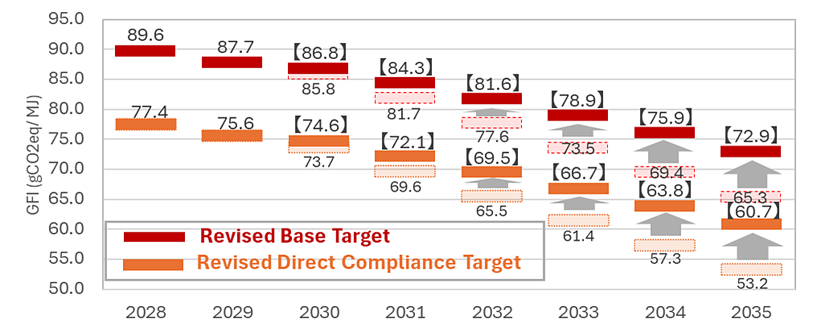
[Source: MEPC 84-7-49]
2) Front-loaded incentive variant: The Direct Compliance Target for the period 2028–2035 would be fixed at 72.9 gCO₂eq/MJ. Within that window, the target would be set more stringently in the early years (2028–2029) to incentivise the early uptake of transitional fuels, with the compliance burden easing progressively in the latter part of the period.
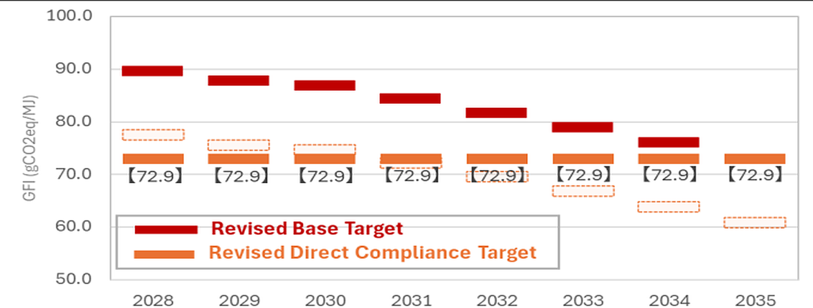
[Source: MEPC 84-7-49]
The proposal's significance lies in three areas: it preserves the existing NZF structure, making consensus more attainable without the burden of renegotiating the framework from scratch; it removes the mandatory fund contribution, addressing a core concern among opposing delegations; and it broadens the space available for transitional fuels.
However, a weakened financial mechanism risks friction with those seeking to retain the current framework, while any easing of GFI targets would dilute the regulatory signal, potentially slowing investment in clean fuels and the expansion of supporting infrastructure. The broader criticism is that this trajectory would move shipping further from the 1.5°C mitigation pathway set out under the Paris Agreement.
Option 2. The Liberia-led 'Pragmatic Proposal': A structural redesign
Where the Japan proposal makes targeted adjustments, this proposal redesigns the framework itself. It operates in three stages.
1. Designation of Candidate Viable Fuels (CVF):
Only fuels meeting all three of the following criteria are eligible for inclusion as CVFs. On affordability, the fuel must be priced within fifteen percent above the cost of conventional fuel. On availability, it must hold a market share of at least five percent and be accessible for bunkering within 2,500 nautical miles in at least five of the seven major shipping regions. On scalability, it must either be a mature fuel with a market share of five percent or more, or an emerging fuel with a compound annual growth rate (CAGR) of at least five percent.
2. Setting the GFI benchmark:
The starting point is GFI Max — the market share-weighted average GFI of fuels currently in use. The endpoint is GFI Min — the GFI of the cleanest commercially available fuel on the market. The trajectory between the two is reduced linearly over thirty years, with a reassessment every five years to incorporate new fuels and market developments.
3. Compliance
Shortfalls may be managed through the accrual, trading, or borrowing of Surplus Units (SUs). Where shortfalls remain unresolved, issuance of the Statement of Compliance (SoC) is withheld. Vessels without valid SoC are subject to detention or denial of entry under port state control (PSC). The core mechanism is one of operational consequences rather than financial penalty — compliance is enforced through a vessel's right to trade, not through monetary charges.
The proposal's significance lies in three areas: it links the reduction pathway to market penetration, cushioning the impact during periods of supply shortage; it lowers the political barriers to agreement by eliminating the RU mechanism and the associated fund; and it avoids technology bias by using a whole life-cycle emissions basis that draws in a broad range of solutions — including carbon capture and wind-assisted propulsion — rather than favouring any particular technology.
On the other hand, concerns remain that a slow-growing market would produce a correspondingly gradual reduction pathway; that the threshold values themselves (fifteen percent, five percent, five percent) would become a new focal point for negotiation; and that eliminating the fund would remove the principal source of financing for a just transition.
Member States: Three Distinct Positions
While MEPC 84 fell short of consensus, the positions of member states have crystallised into three distinct groupings..
| Group A | Group B | Group C |
Position | Retain the NZF as drafted | Targeted adjustments | Fundamental revision or replacement |
Representative states | EU and Small Island Developing States (SIDS), among others | Japan, Singapore, China, among others | United States, Saudi Arabia, Russia, Liberia, among others |
Core rationale | Prioritises policy consistency and regulatory credibility. Views the financial mechanism as essential, particularly given the scale of transition costs and supply-side uncertainty | Seeks to preserve the existing structure while pursuing compromise at a level that can attract consensus | Calls for a comprehensive review centred on technology neutrality and practical implementability |
Associated proposal | - | Japan proposal | Liberia proposal |
Timeline of Scenario Progression
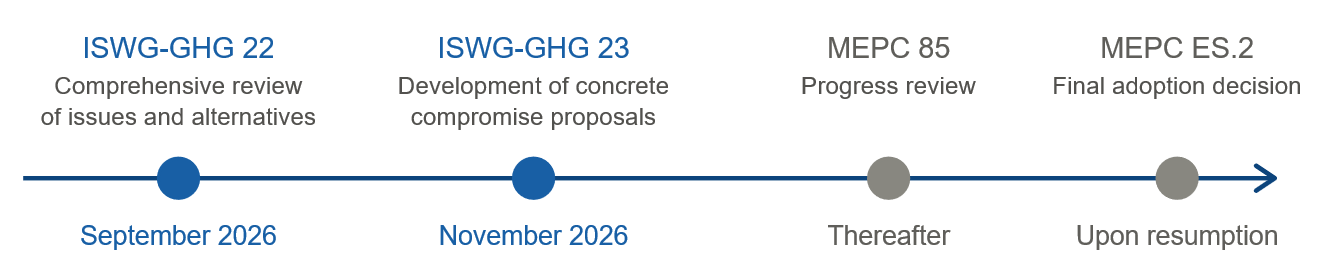
It should also be noted that the Terms of Reference (ToR) do not confine discussions to any specific proposal but guarantee the free submission of alternatives and new proposals. This leaves open the possibility of third or fourth options emerging beyond those put forward by Japan and Liberia.
Crucially, a delay in reaching IMO consensus will not produce a regulatory vacuum. The EU ETS has required full surrender of allowances for shipping from this year, FuelEU Maritime tightens annually, and the United Kingdom has brought shipping within the scope of its own ETS, also this year. The longer IMO consensus is deferred, the more an environment takes shape in which different standards, reporting frameworks, and cost structures apply from port to port. At the same time, market-led initiatives, including green shipping corridors, clean fuel supply partnerships, and ammonia and methanol demonstration projects, together with ESG requirements from cargo owners and financial institutions, are independently shaping a clean fuel market of their own.
Conclusion
Across all scenarios, the destination remains net zero by 2050. A slower pace of emissions reduction in the near term will ultimately result in greater pressure later. The current transition period should therefore be viewed not as a time of uncertainty, but as a preparatory phase for the long-term decarbonization framework ahead.
From an industry perspective, this presents two concurrent challenges. Shipowners must navigate fragmented regional regulations while responding to market-driven demand for clean fuels. This requires a flexible fuel portfolio strategy, as the optimal fuel mix and timing of the transition will depend on the proposal ultimately adopted. Keeping options open across LNG, biofuels, methanol, and ammonia will be essential to responding quickly to any outcome.
KR is closely monitoring these developments. The remaining ISWG-GHG and MEPC sessions will determine the final shape of the NZF. By analysing proposals, changes to the Terms of Reference (ToR), and evolving positions among member states, KR aims to help shipowners and the wider industry prepare fuel strategies, operational plans, and certification and reporting frameworks in advance of regulatory finalization. Anticipating change rather than waiting for certainty will be a competitive advantage—and KR is committed to supporting that preparation.