
-
- KR Celebrates 66th Anniversary with Well-Attended Technical Seminar
- KR Launches First North Europe Committee and Technical Seminar in Hamburg
- KR Demonstrates Technical Expertise In IMO Deliberations on The Amendments of International Regulation for Gas Carriers
- KR Signs Mou With Microsoft Korea For AI And AX-Driven Digital Classification and Shipbuilding & Maritime Innovation
- KR Demonstrates Technical Expertise In IMO Deliberations On The Amendment Of International Regulations For Gas Carriers
- KR Publishes “Numerical Calculation Guidelines for the Determination of the Attained EEDI” Jointly with HD Hyundai Heavy Industries and Samsung Heavy Industries
- KR and HD Hyundai Samho Complete “AI-Technology-Based Solutions for Innovating Design and Analysis Work”
- KR Leads Technical Verification of Geumyang Shipping’s Electric Hybrid Vessel - Achieves Eco-Friendly Grade 3 Certification
- KR Launches “Integrated Seoul Training” on Shipping Decarbonization
- KR Celebrates 66th Anniversary with Well-Attended Technical Seminar
- KR Launches First North Europe Committee and Technical Seminar in Hamburg
- KR Demonstrates Technical Expertise In IMO Deliberations on The Amendments of International Regulation for Gas Carriers
- KR Signs Mou With Microsoft Korea For AI And AX-Driven Digital Classification and Shipbuilding & Maritime Innovation
- KR Demonstrates Technical Expertise In IMO Deliberations On The Amendment Of International Regulations For Gas Carriers
- KR Publishes “Numerical Calculation Guidelines for the Determination of the Attained EEDI” Jointly with HD Hyundai Heavy Industries and Samsung Heavy Industries
- KR and HD Hyundai Samho Complete “AI-Technology-Based Solutions for Innovating Design and Analysis Work”
- KR Leads Technical Verification of Geumyang Shipping’s Electric Hybrid Vessel - Achieves Eco-Friendly Grade 3 Certification
- KR Launches “Integrated Seoul Training” on Shipping Decarbonization
-
- KR Celebrates 66th Anniversary with Well-Attended Technical Seminar
- KR Launches First North Europe Committee and Technical Seminar in Hamburg
- KR Demonstrates Technical Expertise In IMO Deliberations on The Amendments of International Regulation for Gas Carriers
- KR Signs Mou With Microsoft Korea For AI And AX-Driven Digital Classification and Shipbuilding & Maritime Innovation
- KR Demonstrates Technical Expertise In IMO Deliberations On The Amendment Of International Regulations For Gas Carriers
- KR Publishes “Numerical Calculation Guidelines for the Determination of the Attained EEDI” Jointly with HD Hyundai Heavy Industries and Samsung Heavy Industries
- KR and HD Hyundai Samho Complete “AI-Technology-Based Solutions for Innovating Design and Analysis Work”
- KR Leads Technical Verification of Geumyang Shipping’s Electric Hybrid Vessel - Achieves Eco-Friendly Grade 3 Certification
- KR Launches “Integrated Seoul Training” on Shipping Decarbonization
By Kim Hosun, Principal Engineer, Ship & Offshore Technology Team
1. Technology Overview
Korea’s cumulative offshore wind operating capacity remains at around 125 MW — including Tamra (30 MW, 3 MW × 10 units), the Southwest Sea demonstration complex (60 MW, 3 MW × 20 units), and Yeonggwang (34.5 MW, 2.3 MW × 15 units). However, projects totaling approximately 18.8 GW are currently in the development stage, and the national target is to complete 12 GW by 2030.
Next-generation complexes such as the recently completed Jeju Hallim (100 MW, 5.56 MW × 18 units) are adopting large turbines of at least the 5-MW class, and projects considering wind turbines of the 15-MW class or larger continue to increase.
Based on GWEC (2022) figures, the global substructure share is dominated by monopiles at 76%; however, demand for jackets is expected to increase in earnest from 2023 onward as turbines grow larger. In fact, among the fixed-foundation offshore wind projects under development in Korea, only one complex has adopted a monopile structure.
Jacket support-structure installation methods are broadly divided into post-piling and pre-piling. Post-piling is a method in which the jacket is first installed at sea and piles are then driven inside the legs; it requires no separate underwater template but extends the offshore installation period, making it less economical for large-scale complexes. Pre-piling is a method in which pile positions are secured in advance using an underwater template before the jacket is set in place; it has numerous overseas application cases and can secure the economics of large-scale complexes by shortening the construction period. However, Korea’s Southwest Sea region has soft cohesive soils distributed to depths of 60 m or more, requiring pile foundations to be embedded 60 m or deeper, and it carries high risks related to the ground settlement of heavy pre-piling templates (650-ton class, 32 m × 32 m).
This research project proposed two new construction methods to address these problems. Type 1 (the pre-suction method) is a structure that joins the jacket and the suction foundation using a gripper and grout on the suction foundation — a separable method between the suction foundation and the jacket structure. Type 2 (the lightweight pre-piling method) applies a Derrick System-based lightweight template that reduces weight by approximately 50% compared with heavy overseas templates, thereby mitigating soft-ground settlement risk and shortening the offshore installation period.
The participating organizations include K-BETS (Korea Blue Energy Total Solution), the lead organization; co-research organizations KR, Hyundai Steel, POSCO E&C, Gentec Engineering, Gwansu E&C, Myeongil Jack-up Offshore, Korea Clamp, Korea Institute of Industrial Technology, Korea University, and Kongju National University; and the demand organizations Kolon Global and Jeonnam Development Corporation.
2. Type 1 (Pre-Suction Method)
In the southwestern coast of Korea, soft cohesive soils are distributed across depths of more than 60 m below the seabed. Because conventional pile-foundation methods must embed piles 60 m or deeper, they incur considerably high foundation costs and long construction periods.
To overcome these drawbacks of pile foundations, active development is underway of Suction Bucket Foundation technology, which offers shorter construction periods and cost savings. The suction foundation penetrates the seabed ground through differential pressure created by internal pumping together with its own weight; it can be installed without pile-driving equipment and minimizes environmental impact thanks to low noise and vibration. Overseas, demonstration cases applying suction foundations have been reported, such as Borkum Riffgrund 1 (Germany) and Aberdeen Bay (U.K.).
However, as the combined weight of the suction foundation and the jacket structure increases substantially with the growing size (15-MW class and above) of offshore wind turbines, there is a shortage of large installation vessels capable of installing them as a single unit, making separate installation of the foundation and support structure unavoidable.
In this measure, the suction foundation is first installed in advance, after which the cone cylinder at the bottom of the jacket support structure is seated on and connected to the capture at the top of the suction foundation; it is then temporarily fixed using a gripper, and grout is injected for permanent fixation. Because the suction foundation itself doubles as a template that secures the pile positions, no separate underwater template is required; and because the foundation and the jacket can be fabricated and transported separately, fabrication yards and equipment can be downsized, and height-restriction problems when passing under bridges are also resolved.
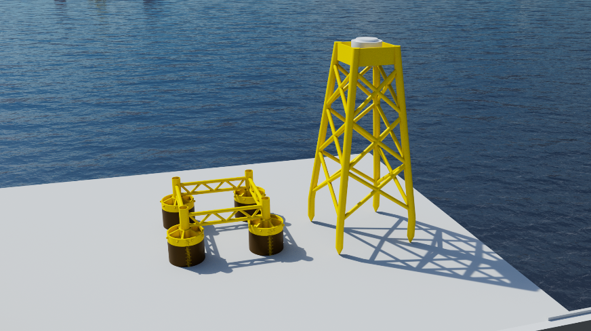
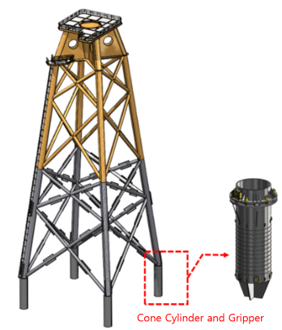
Pre-suction jacket support-structure configuration and gripper system (K-BETS).
3. Type 2 (Lightweight Pre-Piling Method)
As noted earlier, owing to the soft-ground conditions of the Southwest Sea region, the two-layer pre-piling templates previously used in Europe induce settlement in soft ground due to their excessive weight (650-ton class), which can lead to reduced installation precision and process delays.
Accordingly, this research proposed a one-layer lightweight pre-piling template (a roughly 50% weight reduction compared with conventional templates) to prevent ground settlement. To compensate for the limitations of the one-layer structure, a Derrick System was applied, adopting a winch-type structure capable of precise measurement, and a sonar-based underwater monitoring system was installed so that underwater conditions can be grasped in real time even in environments where visibility is impaired by suspended sand.
The key is that weight reduction can greatly mitigate settlement problems in soft ground, while the precise control function of the Derrick System improves pile-position accuracy and thereby enhances the constructability of the jacket support structure.
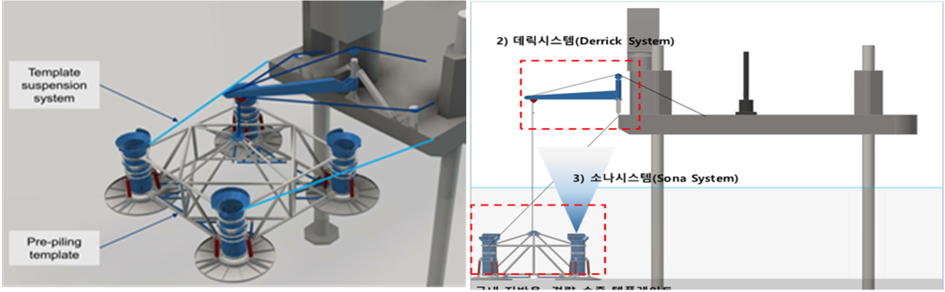
Lightweight pre-piling jacket installation method (Hyundai Steel Industries).
4. Future Plans and Korean Register’s Role
This research project is proceeding with the goal of finalizing a test bed in Phase 1 and carrying out a 1/15-scale demonstration in Phase 2. It sets a quantitative target of shortening the offshore installation period by approximately 25% compared with the conventional method and is also pursuing a 2–3.5% weight reduction through the application of higher-strength steel and an additional 5–10% weight reduction through fatigue-life-enhancing steel.
To ensure the successful execution of this technology, Korean Register is carrying out an Approval in Principle (AIP) for the construction method and developing risk-assessment-based safe-work guidelines as well as transport/installation guidelines. Through AIP approval, KR will verify the validity of the new method in advance, and it intends to use the developed transport/installation guidelines as Marine Warranty Survey (MWS) criteria, contributing to the diversification of its revenue model. KR also aims to institutionalize safe-work guidelines for offshore wind construction methods in the form of rules or guidelines, thereby developing this into a domestic offshore-wind construction safety-certification business.
This technology is expected to realize the localization of core offshore-wind substructure construction technologies — previously wholly dependent on overseas sources — and to open the possibility of technology exports to overseas markets with similar seabed-ground environments.