
-
- (2025-IMO-17) Amendments to Pilot Transfer Arrangement Requirements Entering into Force on 1 January 2028.
- Notice for Establishment to the KR Technical Rules(Guidance for Approval of Additive Manufacturing(3D Printing))
- New SOLAS regulation II-1/3-13 lifting appliance and anchor handling winch on 1st January 2026.
- (2025-ETC-03) Development of Polar Code Implementation Guide and Support Program
- (2025-IMO-17) Amendments to Pilot Transfer Arrangement Requirements Entering into Force on 1 January 2028.
- Notice for Establishment to the KR Technical Rules(Guidance for Approval of Additive Manufacturing(3D Printing))
- New SOLAS regulation II-1/3-13 lifting appliance and anchor handling winch on 1st January 2026.
- (2025-ETC-03) Development of Polar Code Implementation Guide and Support Program
-
- (2025-IMO-17) Amendments to Pilot Transfer Arrangement Requirements Entering into Force on 1 January 2028.
- Notice for Establishment to the KR Technical Rules(Guidance for Approval of Additive Manufacturing(3D Printing))
- New SOLAS regulation II-1/3-13 lifting appliance and anchor handling winch on 1st January 2026.
- (2025-ETC-03) Development of Polar Code Implementation Guide and Support Program
LEE Hongku, KIM Jongmin
KR System Safety Research Team
1. Introduction
Recently, there has been active progress in utilizing ammonia as an eco-friendly alternative fuel for ships. However, regulations and procedures for safely performing ship-to-ship (STS) ammonia bunkering are not yet fully established. Furthermore, as the ordering and construction of ammonia carriers and ammonia-fueled propulsion ships continue, there will be a need for safe bunkering procedures for these vessels. In particular, since ammonia is highly toxic and can cause serious risks to human life and the environment if leaked, thorough safety management is essential. For safety management, it is necessary to designate and control safety management zones.
The safety management zone is established based on the dispersion distance corresponding to a specific concentration determined through leak analysis. However, there is currently limited data on dispersion distance calculations for potential ammonia leakage incidents during ship to ship bunkering operations. Existing studies indicate that ammonia shows longer dispersion distances compared to other alternative fuels such as LNG, in some cases even exceeding the full length of the vessel. Therefore, in this paper, we assumed a domestic port where future ship to ship ammonia bunkering operations are expected to take place and calculated the dispersion distance of ammonia leakage accidents using the commercial software PHAST. Based on this, we estimated the approximate dispersion distances that may occur during bunkering related leakage scenarios. In addition, we reviewed relevant regulations on personal protective equipment (PPE) essential for safe operations during leakage accidents and proposed appropriate protective equipment.
2. Dispersion Distance Analysis
During ship-to-ship bunkering operations, leakage accidents were assumed under two scenarios to calculate the dispersion distance.
• Case 1: Leakage begins due to damage at the hose connection (e.g., gasket, fitting), and continues until the emergency shutdown (ESD) valve is activated, which is assumed to take 1 minute.
• Case 2: Leakage occurs due to damage to the hose itself, with the same assumption that ESD activation requires 1 minute.
In both scenarios, it is further assumed that residual ammonia inside the hose continues to leak even after ESD activation. The size of the damage to the hose and fittings was referenced from the SGMF LNG bunkering guidelines. 1)
Table 1 shows the sizes of the leakage openings. The supplying and receiving vessels involved in the bunkering operation were not specified, and the bunkering specifications were referenced from other research institute reports and academic papers. 2)
Case | 고장 내용 | 누출구(mm) |
1 | Bunkering hose connection damage (e.g., gasket, fitting) | 5.0 |
2 | Bunkering hose damage | 12.0 |
Table 1. size of leak opening
The meteorological conditions were based on the 2024 weather data for the relevant area, applying an annual average temperature of 15.5 ℃, wind speed of 2.1 m/s, relative humidity of 67%, and cloud cover of 50%. For the calculation of ammonia dispersion distance, the endpoint concentrations were set as 300 ppm, corresponding to the workplace acute health hazard concentration (IDLH) defined by the U.S. National Institute for Occupational Safety and Health (NIOSH), and 1,600ppm, corresponding to the acute exposure guideline level (AEGL-3) established by the U.S. Environmental Protection Agency (EPA).
The calculated dispersion distances ranged from 73 to 259 m at 1,600 ppm and from 145 to 920 m at 300 ppm. From a conservative perspective, the distances can be considered as approximately 259 m at 1,600 ppm and 920 m at 300 ppm. Under the assumed conditions, the analysis indicates that the dispersion distance of an ammonia leak during ship to ship bunkering approximately exceeds the overall length (L) of the vessel. This implies that all personnel on board could potentially be within the affected area. Furthermore, the results suggest that the safety distance required to prevent toxic exposure to ammonia is significantly greater than the safety distances for flammable fuels such as LNG, which primarily focus on explosion and fire prevention. Therefore, a higher level of caution is required along the entire length of the vessel during ammonia bunkering operations.
3. Response Measures for Leakage: Personal Protective Equipment
As reviewed above, the dispersion distance of ammonia leakage can extend across the entire length of a vessel. Therefore, workers handling ammonia must be equipped with appropriate personal protective equipment (PPE). Regulations and guidelines on PPE required for ammonia handling and leakage response have been examined from both domestic and international organizations, including IMO/IBC Code, Domestic law, Classification Society, and SGMF. The findings are summarized in the following table 2.
Regulation |
Contents | |
Chemical Substances Control Act / Regulation on the Use of Personal Protective Equipment by Hazardous Chemical Handlers | Article 4 Use of Protective Equipment by Ammonia Handlers |
① Wear ammonia gas masks (or higher), chemical protective suits (Type 3 or Type 4 or higher), and safety gloves.
|
Article 7 Provision of Protective Equipment (Emergency Response)
| Workplaces handling ammonia must be equipped with full-face supplied-air respirators or self-contained breathing apparatus, as well as Type 1 or Type 2 protective suits, in order to ensure rapid initial response such as leakage containment in the event of a chemical accident.
| |
Occupational Safety and Health Act / Rules on Occupational Safety and Health Standards | Technical Guidelines for the Selection of Respiratory Protective Equipment for Workers Handling Chemical Substances |
When the IDLH concentration (300 ppm) is exceeded, use supplied-air respirators (airline) or self-contained breathing apparatus (SCBA). |
IBC Code Ch 14. KR Rules Pt 7/Ch 6 | 14.1 Protective equipment | 14.1.1 For the protection of crew members who are engaged in loading and discharging operations, the ship shall have on board suitable protective equipment consisting of large aprons, special gloves with long sleeves, suitable footwear, coveralls of chemical-resistant material, and tight-fitting goggles or face shields or both. The protective clothing and equipment shall cover all skin so that no part of the body is unprotected.
|
14.2 Safety equipment | 14.2.1 Ships carrying cargoes for which 15.12, 15.12.1 or 15.12.3 is listed in column “o” in the table of chapter 17 shall have on board sufficient but not less than three complete sets of safety equipment, each permitting personnel to enter a gas-filled compartment and perform work there for at least 20 min. 14.2.2 One complete set of safety equipment shall consist of: .1 one self-contained air-breathing apparatus (not using stored oxygen); .2 protective clothing, boots, gloves and tight-fitting goggles;
| |
14.3 Emergency equipment | 14.3.1 Ships carrying cargoes, for which "Yes" is indicated in column “n” of chapter 17, shall be provided with suitable respiratory and eye protection sufficient for every person on board for emergency escape purposes, subject to the following: .1 filter-type respiratory protection is unacceptable; .2 self-contained breathing apparatus shall have at least a duration of service of 15 min;
| |
KR Guidance for Classification of Ships Using Low-flashpoint Fuels/Annex 7 Requirements for Ships Using Ammonia as Fuel (IMO SC.1/Cir.1687 reflected) | 2003. Protective equipment | 1. Suitable protective equipment, including eye protection, to a recognized national or international standard, should be provided for protection of crew members engaged in normal operations related to the ammonia fuel system. 2. Personal protective and safety equipment required in this section should be kept in suitable, clearly marked lockers located in readily accessible places.
|
2004. Emergency equipment | 5. Suitable respiratory and eye protection for emergency escape purposes should be provided for every person on board, subject to the following: (1) filter-type respiratory protection is unacceptable; (2) self-contained breathing apparatus should have at least 15 minutes of service time;
| |
SGMF AMMONIA1 |
Operators and other personnel in an area where ammonia is likely to be present but with a low risk of exposure |
Cartridge-type gas masks, hard hat, face shield/goggles and gloves
|
Operators responsible for tasks such as connecting the bunkering system or undertaking maintenance: a higher risk of encountering ammonia leaks and splashes |
Lighter chemical suit enough to shield against ammonia-related hazards, and full-face mask with ammonia removal cartridge
| |
Emergency responders are tasked with accessing contaminated areas to render the system (e.g. to close valves)
| Gas tight suit with full coverage for the entire body, and self-contained breathing apparatus(SCBA)
| |
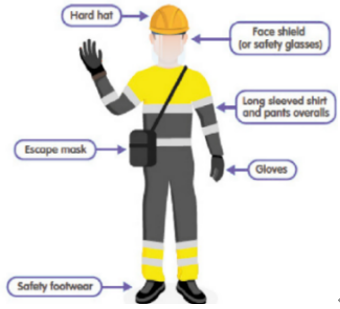
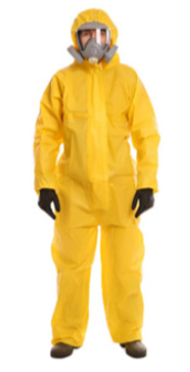
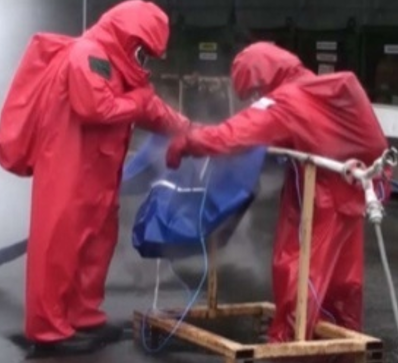
Table 2. Domestic and International Regulations for PPE
Based on the review of the above regulations and the current use of PPE during actual ammonia bunkering operations, the PPE requirements for ammonia bunkering personnel are proposed according to the type of bunkering activity, as summarized in Table 3 below.
Work type |
Personal Protective Equipment |
• Indirect bunkering personnel |
Ammonia rated gas mask (or higher), chemical protective suit (Type 3 or Type 4 or higher), and safety gloves to be carried or kept readily available nearby |
• Direct bunkering personnel (e.g., hose connection, maintenance workers)
|
Wear ammonia gas mask (or higher), chemical protective clothing (Type 3 or 4 or higher), and safety gloves |
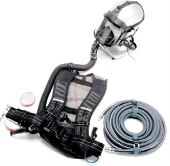
• Leakage response personnel
|
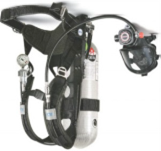
Wear full-face supplied-air respirator or self-contained breathing apparatus (SCBA) together with Type 1 or 2 protective clothing
|
4. Conclusion
In this study, ammonia dispersion distances were analyzed under the assumption of a leakage accident during ship to ship (STS) ammonia bunkering operations, and corresponding response measures were examined. The analysis showed that the dispersion range of ammonia could exceed the overall length of the vessel, indicating that the impact may not be limited to the bunkering work area but could extend throughout the entire ship. This highlights the need for a different safety distance approach compared to flammable fuels such as LNG, given the toxic characteristics of ammonia.
In addition, a review of domestic and international regulations, along with current on site practices, revealed that personal protective equipment (PPE) for ammonia bunkering personnel should be applied differentially depending on the type of task and associated risk level. In particular, higher level protective equipment - such as supplied air respirators or self contained breathing apparatus - was identified as essential for responding to leakage incidents.
For the future implementation of ammonia bunkering, it will be necessary to conduct dispersion analyses that reflect actual port conditions and weather factors, establish safety management zones tailored to the properties of ammonia, and develop detailed PPE requirements and emergency response procedures for each operational stage.